
Is This the Future of Farming in Barbados? Inside INO-GRO’s High-Tech Approach to Food Security
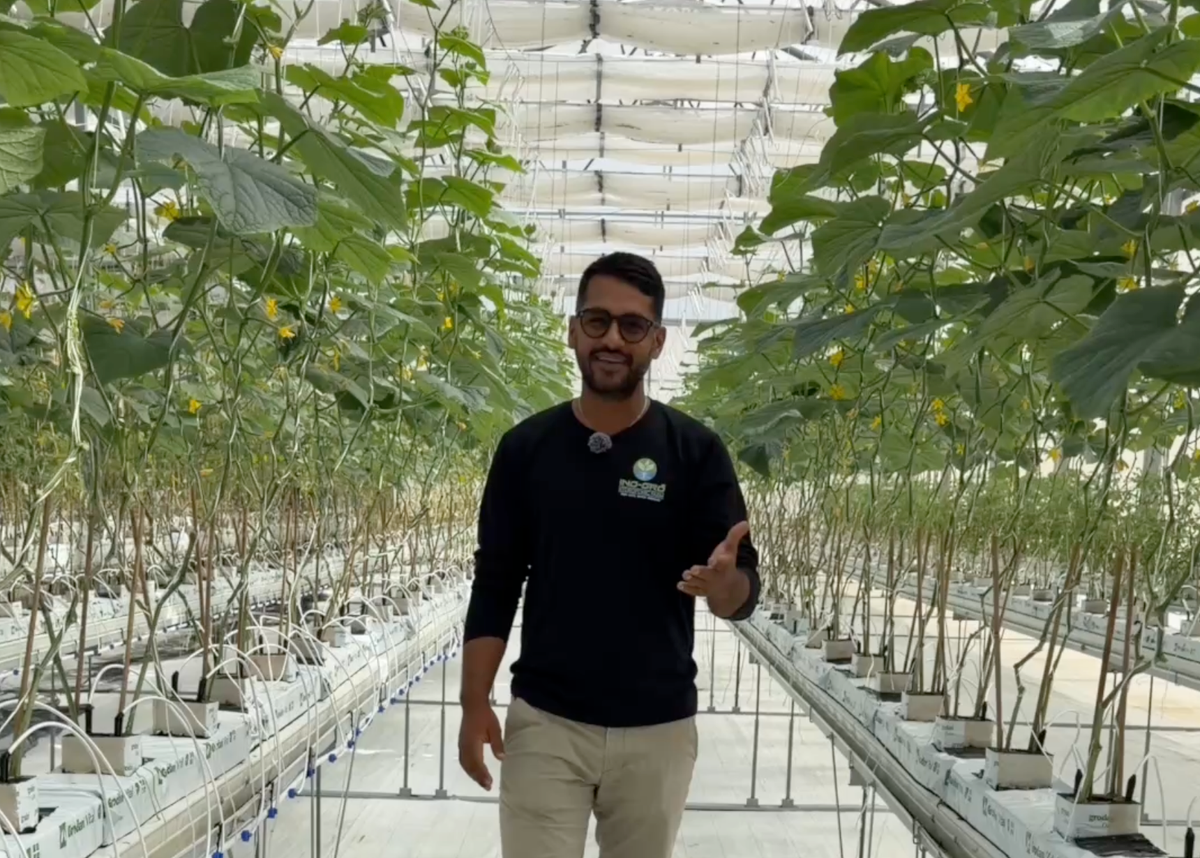
What if some of the food we currently import into Barbados could instead be grown right here, year-round, inside highly controlled environments where technology helps farmers monitor almost everything a plant needs?
That future may be closer than we think.
Inside a 16,000-square-foot facility in Barbados, INO-GRO Managing Director Rishi Panjwani and his team are experimenting with a different approach to Caribbean agriculture, combining protected farming, specialised equipment, sensors, data and carefully controlled growing conditions.
And while INO-GRO is still learning, testing and refining its model, its ambition extends well beyond one greenhouse or one island.
The goal is to develop a system that can eventually be replicated throughout the Caribbean, increasing regional food production, strengthening food security and reducing our dependence on imported food.
It is an ambitious vision, but also one that speaks directly to one of the Caribbean's most persistent challenges.
The Caribbean Has a Food Problem
We love food in the Caribbean. The problem is that we don't produce nearly enough of what we consume.
Caribbean countries can import a significant percentage of the food they consume, leaving small island states particularly exposed to changes in international prices, transportation costs, supply-chain disruptions and global events.
CARICOM has been working to reduce the region's food import bill and increase local and regional production, with food security becoming an increasingly important priority.
That money represents far more than a statistic.
Every fruit, vegetable or other food item that we can competitively produce within the Caribbean represents an opportunity to keep more money circulating within our economies, support local businesses, create employment and make our food supply more resilient.
The challenge is figuring out how to produce more food within the realities of small Caribbean states, where agricultural land and freshwater can be limited and climate conditions are becoming increasingly unpredictable.
That is where innovation becomes important.
We Also Need to Change How We Think About Farming
There is another challenge facing Caribbean agriculture, and it isn't simply technological.
It's cultural.
For generations, farming across parts of the Caribbean has sometimes been associated with back-breaking manual labour, long hours in the sun and getting your hands dirty.
The history of agriculture in our region is also inseparable from colonialism, plantation economies and forced labour, which has helped shape how agricultural work has been perceived over time.
Even today, farming is not always the career young Caribbean people imagine when they think about technology, entrepreneurship or innovation.
But agriculture is changing.
Across the world, the farmer of the future may be just as comfortable looking at a computer screen, analysing data and adjusting automated systems as working directly with soil and crops.
And INO-GRO gives us a glimpse of what that can look like in Barbados.
Inside INO-GRO: Where Farming Meets Technology
Walk into INO-GRO's facility and one of the most important areas isn't a field.
It's the pump room.
Rishi describes it as the "brains of the operation."
Controls and sensors throughout the facility feed information back into this central system. The team can track and adjust factors including pH, electrical conductivity, salinity, humidity and greenhouse temperature.
They can monitor when plants were fed and analyse environmental conditions such as available sunlight.
The objective is straightforward: understand what the plants need and create the conditions to give it to them as consistently as possible.
Instead of leaving every variable entirely to nature, controlled-environment agriculture gives growers another set of tools.
That matters in a Caribbean context.
Modern farming technologies, including protected agriculture, hydroponics, automated irrigation and sensor-based monitoring, are increasingly being explored as ways to improve productivity and make better use of limited resources.
This doesn't make farming effortless.
It makes farming more precise.
From Experiment to Supermarket Shelf
INO-GRO isn't simply testing technology for technology's sake.
The end result still has to be food people can buy and eat.
After approximately three months of production, Rishi says the facility had already achieved successful harvests and yields of European cucumbers and cherry tomatoes.
Those products have made their way onto shelves at Massy Stores and Food First in Newton.
The team isn't stopping there.
INO-GRO is continuing its trials and testing, including plans to introduce peppers as it learns more about how different crops perform within the system.
That experimentation is important because this is ultimately about developing a model that works commercially in Caribbean conditions.
Rishi's longer-term vision is essentially to learn, improve and then replicate.
As he puts it: "copy and paste, rinse and repeat" across the Caribbean.
Could Barbados Become a Blueprint?
One greenhouse isn't going to solve the Caribbean's food-security challenge.
But that isn't really the point.
What makes projects like INO-GRO interesting is the possibility of developing repeatable models.
If farmers and agricultural entrepreneurs can determine which crops work, what technology is needed, how much water and energy production requires, what yields are commercially sustainable and how these operations can be efficiently scaled, those lessons can become valuable far beyond a single farm.
The future of Caribbean farming therefore doesn't have to mean abandoning traditional farmers or traditional agriculture.
It means adding more tools to the toolbox.
Traditional open-field farming, greenhouses, hydroponics, aquaponics, precision agriculture, protected agriculture, automation and other systems can all potentially form part of a more diverse and resilient regional food network.
You Don't Need a 16,000-Square-Foot Facility to Start
Perhaps one of the most important lessons from INO-GRO has nothing to do with the size of the facility.
It is simply this:
Start somewhere.
A homeowner isn't going to reproduce INO-GRO's commercial operation in their backyard. But someone curious about modern agriculture can experiment on a much smaller scale.
Small hydroponic or aquaponic systems can be built or purchased for home use. A backyard grower can begin learning about water quality, nutrients, growing media, plant health and efficient food production with only a handful of plants.
A traditional farmer might test a small area under protected cultivation.
A student might begin experimenting with sensors or automation.
An entrepreneur might see an entirely new agribusiness opportunity.
Not every experiment will become a commercial farm, nor does it need to.
The more Caribbean people who become curious about how we can produce food better, the larger our pool of knowledge, experience and potential solutions becomes.
Five Years Before Anyone Saw the Greenhouse
There is another side to Rishi's story worth remembering.
Looking at a sophisticated 16,000-square-foot facility today, it is easy to assume that the business simply appeared fully formed.
It didn't.
Rishi says what people see today represents approximately five years of hard work, research and development, dedication and persistence.
His advice extends beyond agriculture.
If you have an idea, start.
You will learn. You will make adjustments. You will grow. And then you keep going.
"Persistence and passion," he says, "are your two keys to success."
It is a lesson that applies equally well to a farmer, entrepreneur, student, creator or anyone trying to build something that doesn't exist yet.
Growing More Than Food
INO-GRO's story matters because it challenges us to reconsider what farming can look like in Barbados and across the Caribbean.
Agriculture can be traditional and technological.
It can involve soil and sensors.
It can happen in a field, a greenhouse or even a small system in someone's backyard.
And our farmers can be growers, scientists, technicians, engineers, entrepreneurs and innovators all at once.
We are not going to eliminate the Caribbean's dependence on imported food overnight. Our geography, economies and limited resources mean imports will always play an important role.
But there is a significant difference between importing what we need and importing what we simply haven't figured out how to efficiently produce ourselves.
That is why experiments like INO-GRO matter.
Rishi and his team are testing, learning and attempting to build a model that could eventually be repeated elsewhere in the region. Whether that exact model becomes the blueprint or simply helps inspire the next generation of Caribbean agricultural innovation, it is a direction worth exploring.
Because greater Caribbean food security will not come from one farmer, one company or one government programme.
It will come from thousands of people deciding that agriculture deserves another look, investing in new ideas and finding smarter ways to grow more of what we eat.
Know someone who should see what the future of Caribbean farming could look like? Share this article with them.
And if you want to discover more Barbadian entrepreneurs, innovators and changemakers who are building, experimenting and pushing our country forward, follow Let's Do It Barbados on social media and subscribe to our newsletter.
Your progress is Barbados' progress.
Let's do it Barbados!